Food expiration dates: sell by, best by and use by
Except for infant formula, the dates on food are not an indicator of the product’s safety and are not required by federal law (USDA FSIS).
What each date means
Best if Used By / Before
A “Best if Used By/Before” date tells you when a product will be of best flavor or quality; it is not a purchase or safety date (USDA FSIS).
Sell-By
A “Sell-By” date tells the store how long to display the product for sale, for inventory management; it is not a safety date (USDA FSIS).
Use-By
A “Use-By” date is the last date recommended for using the product while at peak quality; it is not a safety date, except on infant formula (USDA FSIS).
Freeze-By
A “Freeze-By” date tells you when a product should be frozen to keep its peak quality; it is not a purchase or safety date (USDA FSIS).
Who decides the date
Manufacturers and retailers set the date, weighing how long and how cold the food is kept on its way to you, what the food is, and how it is packaged (USDA FSIS).
There are no uniform or universally accepted phrases for these dates in the United States, so labels use a wide variety of them (USDA FSIS).
On meat, poultry and egg products a date is voluntary, but one that is used must give the month and day (and the year on shelf-stable and frozen products) next to a phrase such as “Best if Used By” that explains it (USDA FSIS).
To cut confusion and wasted food, FSIS recommends that manufacturers and retailers who date their food use “Best if Used By” (USDA FSIS).
When the date has passed
The quality of perishable food may decline after the date passes, so check it for signs of spoilage before you eat it (USDA FSIS).
Food that develops an off odor, flavor or texture has spoiled, and should not be eaten (USDA FSIS).
A change in the color of meat or poultry is not an indicator of spoilage (USDA FSIS).
Handling matters before and after the date: FSIS’s example is cold chicken salad left out above 40 °F for more than two hours (one hour at 90 °F or above), which should not be eaten (USDA FSIS).
Infant formula
Dates on egg cartons
A “Sell-By” or “Expiration” date on eggs is not a federal rule, but the egg laws of the state where they are sold may require one, and some states don’t allow a sell-by date (USDA FSIS).
Cartons with the USDA grade shield must show the pack date: a three-digit code for the day of the year the eggs were packed, from 001 for January 1 to 365 for December 31 (USDA FSIS).
On those cartons, a sell-by date can be no more than 30 days after the pack date (USDA FSIS).
Keep eggs in their original carton in the coldest part of the fridge, not in the door (USDA FSIS).
Codes on cans
Cans must show a code or the date of canning; the code is for tracking and recalls, and is not meant to be read as a “Best if Used By” date (USDA FSIS).
High-acid canned foods such as tomatoes and fruit keep their best quality for 12 to 18 months, and low-acid canned foods such as meat and vegetables for two to five years (USDA FSIS).
Throw away cans that are dented, rusted or swollen (USDA FSIS).
How long food keeps
FoodSafety.gov’s cold food storage charts give fridge and freezer times for common foods (FoodSafety.gov).
Sources
USDA Food Safety and Inspection Service: Food Product Dating
FoodSafety.gov: Cold Food Storage Charts
This page sums up USDA guidance as FSIS published it in November 2026. It is not food-safety advice of our own.

Keep track of your food
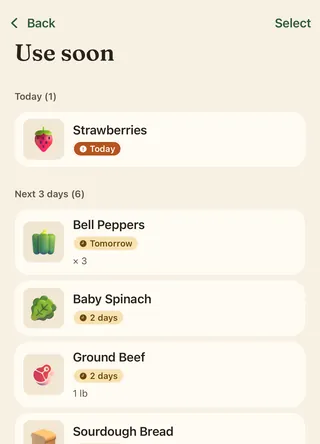
Virtual Pantry keeps track of the food in your fridge, freezer and pantry and reminds you before it expires.

Get new food guides by email
New features, new food guides and kitchen tips. Only when there's news. Unsubscribe any time.